France’s new build property prices dropped 2.5% to €318,014 in September 2026, with 68.4% of cities seeing declines. Despite the national downturn, big swings and gains in select cities hint at market opportunities for savvy buyers and investors. Explore the latest trends and what they mean for the French real estate market.
France’s New Build Property Prices in September 2026: National Downturn Conceals Regional Volatility and Opportunities
A Shifting Landscape for France’s New Build Market
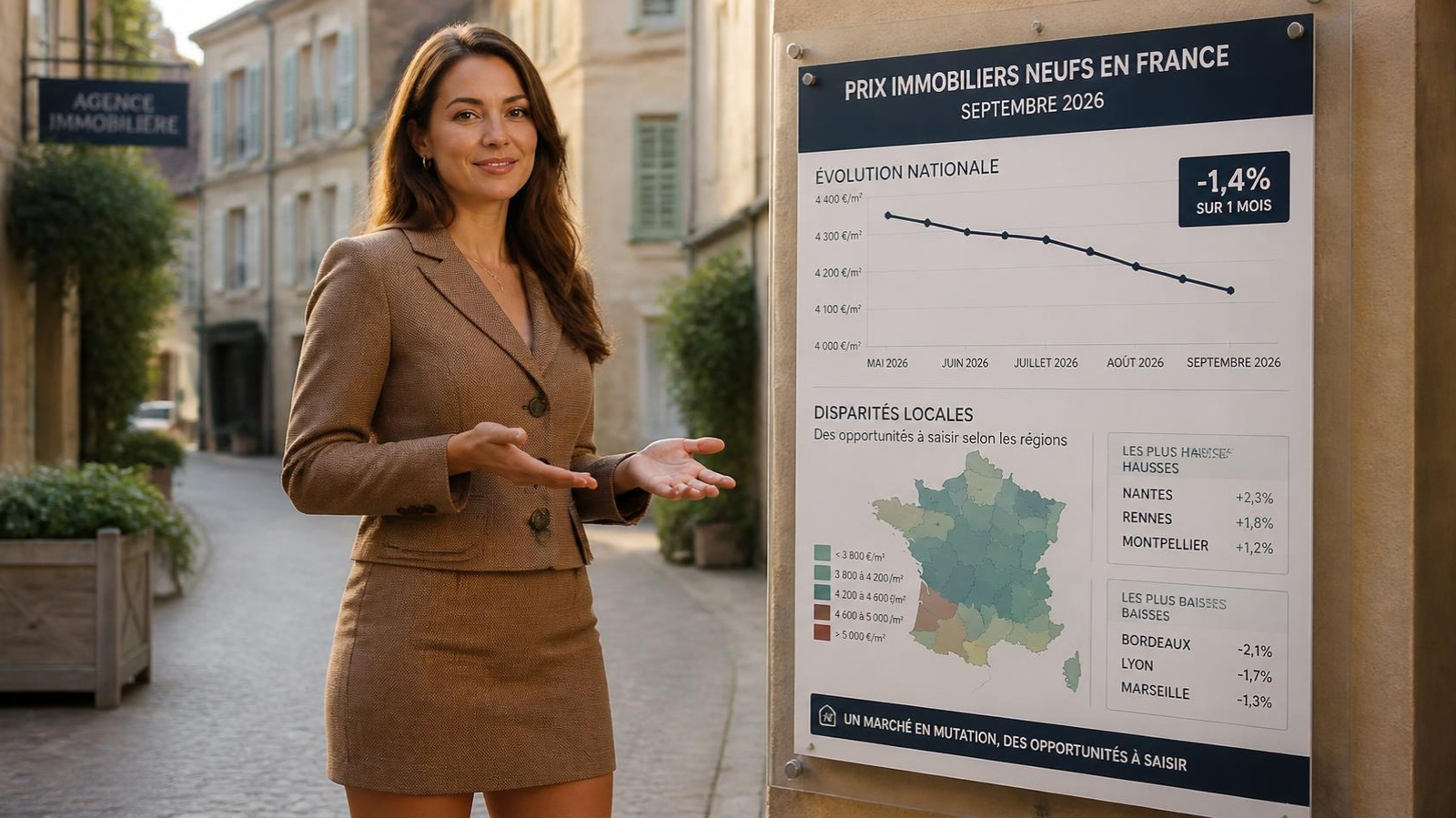
France’s new build property market continues to evolve amidst economic headwinds and shifting buyer demand. The September 2026 barometer from Trouver-un-logement-neuf.com, profiling 79 French cities, reveals a deepening correction: nearly 68.4% of urban markets are experiencing falling prices for new apartments, yet this average masks intense local fluctuations—some regions posting double-digit losses, others displaying unexpected resilience.
Summary Table: Key September 2026 New Build Price Trends
| Metric | Value (Sep 2026) | Change (6 months) |
|---|---|---|
| National Avg. (New T3 Apartment) | €318,014 | -2.49% |
| Median Price (New T3 Apartment) | €290,000 | -1.69% |
| Share of Cities with Declining Prices (T3) | 68.4% | |
| PACA Region Average Decline | -6.77% | |
| Largest City Drop (La Ciotat) | -18.37% | |
| Largest City Gain (Bihorel) | +32.90% | |
| Paris (Highest Avg. Price) | €878,000 | +2.16% |
| Bourg-en-Bresse (Lowest Avg. Price) | €190,400 | |
| Max. City Price Gap | €687,600 |
The Ongoing Correction: A National Downturn Gains Pace
After months of warning signs, the market for new build properties in France has entered a phase of pronounced correction. As of September 2026:
- Average national price for a new three-bedroom apartment (T3): €318,014 (down 2.49% from March 2026)
- Median new build price: down to €290,000 (falling 1.69%)
- Cities with falling prices: 68.4% (54 out of 79 tracked cities)
- This follows a trend from Spring 2026, when 63% of cities had already started to decline.
Why Are Prices Falling Despite Limited Supply?
One might expect a shortage of available new homes to keep prices buoyant. Instead, developers—facing slower sales and persistent high-interest rates—are slashing prices, particularly for the last remaining units in soon-to-close developments. Their aim is to encourage sales and stimulate market movement.
Key factor:
The zero-interest government loan (PTZ), extended and expanded since 2024, remains crucial for first-time buyers, but has regionally uneven impact due to price eligibility thresholds.
Volatility Behind the Average: Dramatic Swings City by City
While the national average points to a correction, the underlying data reveals a market in flux. Cities can swing by more than 15%—in either direction—over just six months.
- Nice: From a Spring 2026 surge (+24.25%) to a September plunge (-14.43%), average new build price now €522,400.
- Brest: A turnaround from a 7.90% fall in Spring to a current +17.12% gain (€305,300).
- La Rochelle: From a slight gain (+6.35%) to a minor drop (-3.15%).
- La Ciotat: Largest observed decline, -18.37%.
Expert Insight:
“These wild price movements stem from a limited number of developments in many cities. Just a handful of new building programs—especially luxury or discounted units—can dramatically shift the average,” explains a senior analyst.
Top 5 Biggest Price Movements (March–September 2026)
| City | % Change | Avg. T3 Price |
|---|---|---|
| Bihorel | +32.90% | N/A |
| Brest | +17.12% | €305,300 |
| La Ciotat | -18.37% | €384,700 |
| Nice | -14.43% | €522,400 |
| Le Mans | -13.62% | €217,500 |
Sharpest Regional Corrections: PACA Takes the Hit
Provence-Alpes-Côte d’Azur (PACA)
The Mediterranean coast leads the latest round of price adjustments:
- Region-wide average change: -6.77% More than double the national decline.
- La Ciotat: -18.37% (€384,700 from €471,300)
- Nice: -14.43% (€522,400)
- Marseille: -9.58% (€355,800)
- Toulon: -8.44%
- Saint-Laurent-du-Var: -7.44%
Yet not all cities are falling:
- Aix-en-Provence: +3.51%
- Vitrolles: +1.61%
The price pressure is uneven—even within the same region. Local market structure and the mix of available new housing determine whether prices crash or hold firm.
Other Key Regions
Rhône-Alpes
- 14 of 16 cities declining.
- Average drop: -2.97%.
- Major decreases: Villeurbanne (-11.53%, €301,400), St-Julien-en-Genevois (-10.64%).
Pays de la Loire
- 4 of 5 cities negative.
- Average drop: -5.07%.
- Le Mans: -13.62%
- Angers: -6.89% (after -7.7% in Spring)
Île-de-France
Greater Paris mirrors national trends:
- 16 of 24 municipalities declining.
- Sharpest losses: Sartrouville (-8.92%), Nanterre (-8.05%), Issy-les-Moulineaux (-6.43%).
- Paris proper: Price rose to €878,000 (+2.16%).
- Puteaux also up (0.78%), highlighting the impact of tightly-constrained supply and ongoing demand in select prime urban areas.
The Two-Speed Property Market: Affordability and Luxury
Largest Price Gaps Across France
| City | Avg. Price (T3) |
|---|---|
| Paris | €878,000 |
| Puteaux | €630,900 |
| Issy-les-Moulineaux | €550,000 |
| Nice | €522,400 |
| Antibes | €441,800 |
| … | … |
| Bourg-en-Bresse | €190,400 |
| La Roche-sur-Yon | €203,900 |
| Angers | €210,900 |
| Le Havre | €216,500 |
| Le Mans | €217,500 |
Difference: With the budget for a single new Parisian apartment, one could buy more than four apartments in Bourg-en-Bresse.
What Drives These Gaps?—Location, Development Mix, and Local Demand
- “Location is the main determinant of price.” In tight markets (Paris, Nice, Lyon), new builds are rare and expensive, whereas smaller cities or those hit by population loss see dramatic falls.
- Program composition: When only 5–6 new developments are available, a luxury residence or sale discounts can drastically skew averages.
Policy & Buyer Impact: The Role of PTZ and Regional Differences
Zero-Interest Loan (PTZ)
The PTZ remains vital for new buyers:
- Extended to 2027 and expanded nationwide for multi-family new builds
- Can finance up to 50% of purchase price, subject to buyer income limits and local price ceilings
However, in expensive areas (Paris, Nice), many new builds exceed PTZ thresholds; thus, its market-boosting effect is felt most in medium and smaller cities, where properties are eligible.
Market Dynamics: Why Is There So Much Volatility?
- Very few active new build programs per city mean that price averages are sensitive to individual building launches or discounts
- High-end launches raise averages quickly
- End-of-sale price cuts bring averages down
This phenomenon drives the extreme swings seen in cities like Nice (+24% to -14%), Brest (-7.9% to +17%), and Bihorel (+32.9%).
Expert Insight:
Property professionals caution buyers to look past the headline national average and analyze each market’s unique supply-demand dynamics.
What Does This Mean For Buyers and Investors?
For Buyers:
- Watch local trends:
- In falling markets, patience may pay off, especially if developers slash prices late in sales cycles
- For those eligible for PTZ, medium-sized cities can offer the best mix of affordability and government support
- In expensive regions, limited eligibility for government loans may mean saving more or compromising on location/space
For Investors:
- Opportunities arise in correcting markets:
- Sharp price drops offer bargains for rental investors, especially in cities with strong long-term rental demand
- Disparity between new and existing property prices can also create arbitrage opportunities
- Risk:
- In markets where employment or population levels are declining, prices may fall further or rental returns soften
- Highly localized volatility means investors should conduct in-depth due diligence and consider economic prospects for each city
France’s New Build Market in 2026 Is a Mosaic, Not a Monolith
The September 2026 new build property barometer highlights a clear trend: there is no “one” French property market—just a national patchwork defined by fierce local dynamics. While the overall trend is downward, price swings of +17% to -18% show that local conditions, supply-side composition, and even a handful of new developments can defy national averages.
Buyers and investors should conduct city-by-city analysis, taking into account:
- Supply/demand imbalances,
- The compositional volatility of small new build samples,
- PTZ eligibility,
- The effect of end-of-sale pricing strategies,
- The longer-term attractiveness of each region.
Those who do their homework can uncover bargains or make confident sales—even in a cooling market.
Expert Perspective:
“This wide range of price evolution—from double-digit drops to surprising gains—means blanket statements about ‘the French market’ are misleading. Today’s new build market is a mosaic of micro-markets, each responding differently to economic, regulatory, and local supply factors,” explains a senior analyst.
The Outlook: What’s Next for France’s New Build Market?
With the correction now firmly underway nationwide, price volatility is likely to continue into 2027. Major metros may see stabilization where supply remains acutely constrained, but price-sensitive outer regions could see further downside, especially if interest rates stay high. For both buyers and investors, informed city-by-city research and professional guidance will be key to capitalizing on the next phase of the market cycle.
Frequently Asked Questions (FAQ)
Q: What is the average price of a new three-bedroom apartment in France in September 2026?
A: €318,014, down 2.49% in six months.
Q: Which region is experiencing the sharpest declines?
A: Provence-Alpes-Côte d’Azur (PACA), with an average drop of 6.77% and some cities (e.g. La Ciotat) posting declines above 18%.
Q: Where are prices still rising?
A: Despite the trend, cities like Brest (+17.12%), Bihorel (+32.90%), Lyon (+3.20%), and Aix-en-Provence (+3.51%) saw increases.
Q: Why are prices so volatile?
A: Many cities have few active new build developments, so a luxury launch or heavy discounting at a late stage can shift the average dramatically.
Q: What should I do if I want to buy a new build in France now?
A: Research local city dynamics, check PTZ eligibility, and consider waiting for further discounts in weaker markets.
Tags:
France new build property prices, 2026 French real estate, new apartment price trend France, PACA real estate market, Paris apartment prices, French property market analysis, new construction France, regional property prices, property investment France, French housing market update
France new build property prices, 2026 French real estate, new apartment price trend France, PACA real estate market, Paris apartment prices, French property market analysis, new construction France, regional property prices, property investment France, French housing market update